Wendy
6/4/2026 8:32:45 AM
4 mins read

A University of Hull economics graduate who became a global movie executive working on box office blockbusters worth more than a billion dollars told his audience at Humber Business Week that he only entered the industry because he was a flop in the world of finance.
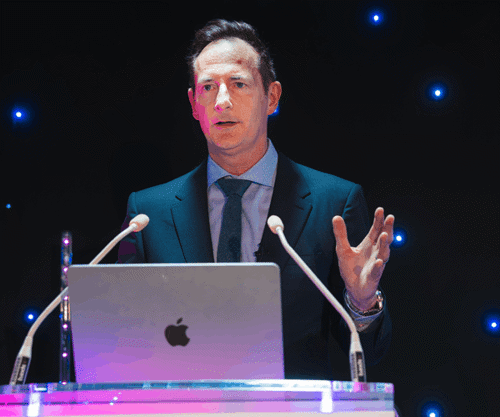
Speaking at the Biz Week launch lunch at the MKM Stadium in Hull, Kieran Breen, said his was the story of “a working class kid and Hull economics graduate who went from Hull to Hollywood”.
He also predicted a bright future for the industry, tipping its capacity to bring people together as the key to helping it overcome the challenges it faces.
Breen revealed he took inspiration from a piece of graffiti – Anarchy is freedom – daubed years ago on a daubed on a wall near Hull’s Paragon Station.
He said: “It defines for me why Hull was the right place at the right time. There’s nowhere like Hull and Hull isn’t trying to be like anywhere else. It doesn’t conform.”
He also quoted from Philip Larkin: “He loved Hull’s unpretentiousness. He said ‘Hull is a city that is in the world yet sufficiently out of it to have a different resonance.’ For me, Hull University was the absolute centre of the universe and a pivotal time in my life that gave me the strength and confidence to pursue a career that at the time I would have thought was beyond my wildest dreams.”
Pointers to the future came from the film reviews which he wrote for Hullfire, the student newspaper, and from his obsession with the first Die Hard movie.
He said: “I remember thinking what would it be like to be on the 14th floor of the Nakatomi Plaza and lookout over the sparkling lights of LA.”
Breen told how he left Hull in 1990. He had a degree in economics and Thatcher had deregulated the financial markets: “I felt the world of finance was my oyster.”
But he said it was “fortunate” that he wasn’t very good at it: “Every interview I failed, one humiliating interview after another. Thank God I didn’t get any of those jobs. I asked myself what is it that you want to do? I’d always loved movies but I didn’t have what it took to be a writer, director or actor.”
He spent a month researching the industry and wrote a hundred letters to different film companies across the UK. When nothing happened he refined his approach: “If I buttered them up with a compliment or two and maybe asked for five minutes of their time I got better results.”
He was offered a job as a publicity intern with Richard Attenborough’s crew working on their 1992 film about Charlie Chaplin, but he missed out when a lack of funding led to the shoot being moved to Budapest.
He turned his attention to smaller companies and Working Title films, now part of Universal, gave him a chance after he visited their “dingy” office in Camden, saw what a mess it was and offered to help out packing boxes free of charge as they were preparing for Cannes. His duties included getting coffee, photocopying, faxing, and carrying reels of film.
He said: “It was a tough job for little or no money but everything they asked me to photocopy I read. I worked harder and longer hours than anyone else and tried to make myself indispensable.”
His timing was perfect because PolyGram were looking to open a studio in London, put money into Working Title and changed everything with Four Weddings and a Funeral.
Breen said: “As PolyGram grew so did I. It was a start-up mentality. I had no qualifications in film or marketing and I just learned on the job but I was getting a really solid understanding of the film industry in the UK and beyond our shores.
When Philips sold PolyGram to Seagram, owner of Universal, Kieran was alerted to an advertisement for a marketing director for 20th Century Fox, and he got the job.
He said: “I had massive impostor syndrome and I thought I was going to get found out but that didn’t happen and I spent five years there with bigger budgets and the opportunity to work on some fantastic movies.”
He missed out on the job of managing director but was told by the recruiter to expect a call about the vacancy for Senior Vice President of international Marketing based in Los Angeles.
He said: “I could hardly believe it. My childhood fantasy was really coming true. My office was on the 14th floor of the Fox Tower, which was the Nakatomi Plaza in Die Hard. It seemed like some strange sort of serendipity.”
One significant title was Avatar: “It earned $2.8 billion and was the most successful film of all time.
Another was Murder on the Orient Express, where he spent 10 minutes talking to Kenneth Branagh, director and co-producer off the film, about Hull: “He told me his sister went to Hull University and it’s a pretty special place. It was an example of how Hull always comes back into my life.”
After the acquisition of Fox by Disney in 2019, Breen went into consulting for media companies and film makers. He is also working with his wife to develop The Shee, a supernatural thriller based on the tragedies that struck down three generations of Oscar Wilde’s family. He maintains his local by serving on the advisory board of Hull University Business School, mentoring Hull University students and delivering guest lectures on film and marketing.
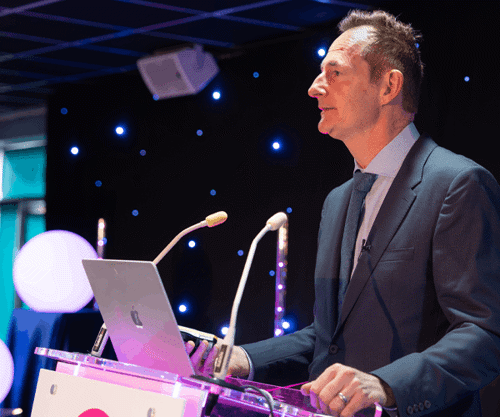
Breen spoke of challenges facing the industry over the years including the advent of home entertainment, the transition from analogue to digital and the disruption of the sector by trillion-dollar businesses which do not have movies and TV at their core.
But he added: “It’s not all bad news. I am supremely confident about this business. Box office forecasts for 2026 are up 4% globally and 10% in the UK. You see audiences voting with their dollars to embrace new film making.”
Breen cited the local example of J Arthur Rank, owner of a flour mill in Hull who went on to launch the Rank Organisation.
“He wasn’t content with filling his customers’ bellies with bread. He wanted to fill their minds with movies. He was a philanthropist who gave back and really understood the importance of communities.”
Having worked on Minority Report, Bridge of Spies and Lincoln, he further illustrated his comments about Rank by drawing on Michelle Obama’s recent interview with Steven Speilberg.
“He was saying that we all consume moves at home whether on Netflix or DVD or whatever and that’s great but it’s not an event.
“Going to the movies is an event. Going at night is fun and going in the afternoon is fun and you turn up in the movie theatre and you are there with people you don’t know. People from different walks of life, and you have nothing in common with them and you may have opposite views but for two hours we are all on the same page.
“We go out and we talk about not what divides us but what unites us and that’s what builds communities and we need those communities now more than ever.”